
Kaufel: Hoffermenters for CO2-Neutral Heat and Power Generation
The initial situation
The family-run Kaufel business combines a restaurant, a farm and a butcher’s shop under one roof. Many of the raw materials required for the business – including feed for the fattening pigs, as well as potatoes and vegetables for the restaurant – are produced on site.
With a view to creating a closed regional cycle, the aim is for manure and other organic waste to be put to good use directly on the farm in future, whilst also being utilised to meet the business’s own energy needs.
The challenge
Various organic waste materials are produced during day-to-day operations – including manure from around 120 pigs, as well as organic waste, food waste and slaughterhouse waste.
The aim was to find a solution that reliably processes these material flows, makes optimal use of existing resources and, at the same time, generates heat and electricity for the farm’s own use.
The solution
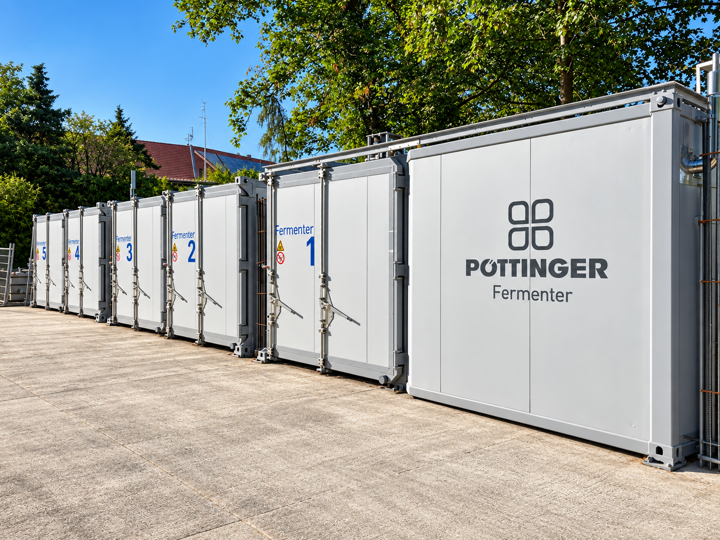
At Kaufel, a PÖTTINGER on-farm digester system with five fermentation boxes is in use. The system is designed for a processing capacity of up to 600 tonnes of organic waste per year.
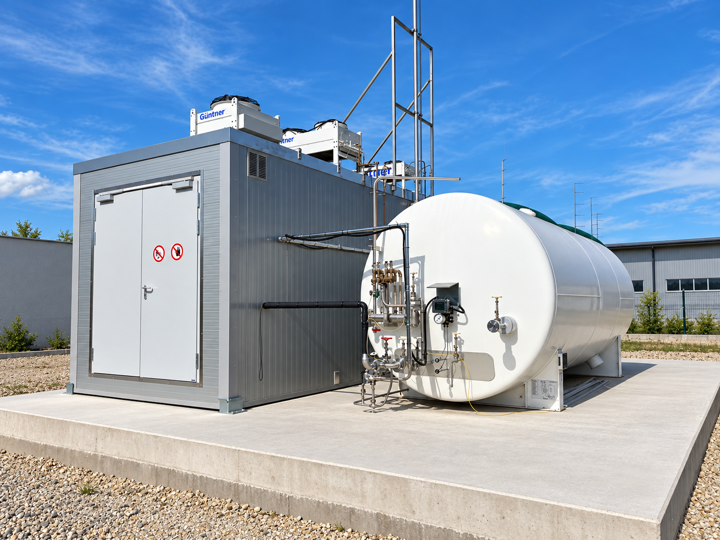
The biogas produced during fermentation is used via a combined heat and power plant to generate electricity and heat. During the day, the existing photovoltaic system supports the energy supply; at night, the stored biogas can be utilised. A gas storage tank with a volume of 40 m³ is available for this purpose.
This plant is the first to utilise a highly efficient combined heat and power unit with exhaust gas recooling. Additional gas cooling and an activated carbon filter ensure that the biogas is processed in a dry and desulphurised state.
This creates a closed-loop system directly on site: organic waste is used to generate energy, self-sufficiency in electricity and heat is enhanced, and existing resources are utilised efficiently.
