
Wiener Neustadt: Making effective use of organic waste
The initial situation
The City of Wiener Neustadt was planning a new solution for the treatment of organic waste from the municipal biowaste collection system. The aim was not only to process the existing material streams efficiently, but also to generate renewable energy for the existing waste treatment facility’s own consumption.
As the first statutory city in Austria, Wiener Neustadt opted for a dry fermentation plant based on PÖTTINGER’s 3-A process.
The challenge
Around 7,500 tonnes of organic waste from the municipal biowaste collection in Wiener Neustadt and the surrounding district are generated every year. These volumes needed to be processed as efficiently as possible while being integrated into a sustainable material and energy cycle.
The required solution therefore had to generate both usable organic material and energy from the biogenic waste and integrate seamlessly into the existing waste treatment facility.
The solution
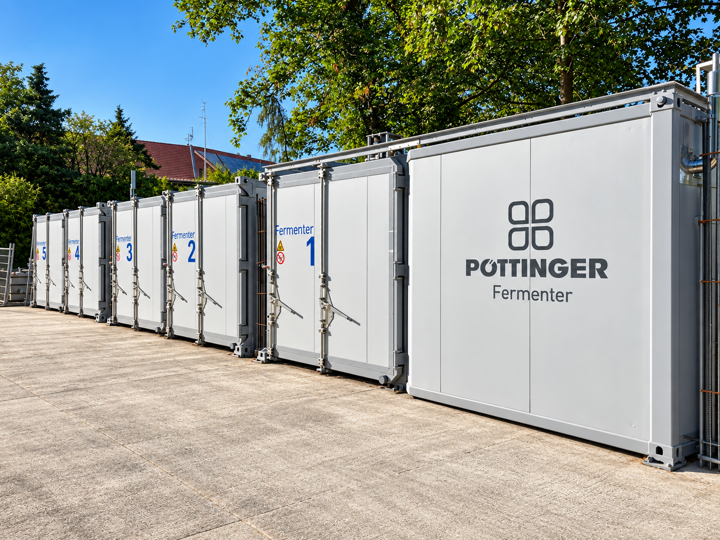
As general contractor, PÖTTINGER Entsorgungstechnik implemented a dry fermentation plant comprising 15 fermenter containers and one technical container. The plant operates according to the 3-A process – aerobic, anaerobic, aerobic – and processes the organic waste into raw compost. At the same time, biogas is produced and used to generate electricity and heat.
The plant generates around 1.2 million kWh of electricity per year, primarily to cover the waste treatment facility’s own energy requirements. According to project data, the energy recovery from the organic waste also saves approximately 700 tonnes of CO₂ per year.
In this way, Wiener Neustadt combines the treatment of municipal biowaste with regional energy generation and high-quality material recovery of organic resources.
